

The AI Trap
The cheapest phase of a technology revolution is the moment customers quietly surrender the ability to leave.
The most expensive moment in a technology transition is rarely the day you buy the technology. It is the day you discover you can no longer say no.
Look at how work is actually being built right now. Software development has moved into AI conversations: the requirements discussion, the design rationale, the iterations and corrections, the skills that encode "how we do it here." The code that lands in the repository can become the only durable residue of a reasoning process the organization did not preserve. And the pattern has broken out of engineering. Accountants are building reconciliation workflows in AI conversations. Customer success teams are building account processes there. In many firms, an increasing share of the company's operational logic is accumulating inside whichever platform IT provisioned, assembled by people who were never given version control, review, testing, or rollback because those disciplines rarely existed in their departments.
None of this requires a villain. Today, artificial intelligence is sold through an irresistible arithmetic: a capable model costs less than an employee, answers in seconds, scales without hiring, and can be added to nearly every workflow. For leaders under pressure to do more with less, refusing that arithmetic can look irresponsible.
But the unit price of intelligence is not the whole price of adoption. A pilot becomes an integration. The integration becomes a workflow. The workflow becomes the way the organization remembers, reasons, approves, and acts. People leave. Internal capability thins. Alternative suppliers become harder to use. Then a change in price, terms, access, or model behavior is no longer a routine vendor event. It is a threat to continuity.
That is the AI trap: not that artificial intelligence is useless, nor that any provider intends harm, but that a useful technology can acquire practical control of a process before its customer recognizes that adoption has also transferred bargaining power.
The trap is not adoption. The trap is dependency without retained authority, memory, or a credible exit.
No monopoly required
This is not an argument about market power, and it does not depend on any provider dominating the industry. The AI market can remain fiercely competitive and the exposure remains because many organizations effectively standardize on one platform. Procurement selects it. IT provisions it. Everyone from engineering to accounting begins building on it. The market stays plural; the firm becomes singular.
That is why the greatest risk is not a dramatic machine rebellion, and not a scheming vendor either. It is a series of sensible local decisions: automate the first draft, remove the duplicate review, centralize the data, retire the old system, reduce the team, accept the proprietary format, let the agent take the next step. Each decision saves money. Together they can erase the organization's practical alternative, with no one, anywhere, having exercised leverage on purpose.
A normal tool improves a task while leaving the surrounding institution intact. A process revolution rearranges roles, knowledge, timing, and control. The organization stops asking, "Should we use this tool?" because the tool has become the environment in which the question itself is asked.
The recurring sequence
Across very different markets, a recognizable sequence appears. It requires nothing illegal and no bad intent. It requires only that dependency grow faster than the customer's ability to exit.
Stage one. Make entry irresistible. The new service is cheaper, easier, subsidized, bundled, or simply better than what came before. Low friction is the wedge.
Stage two. Become the default route. Volume moves toward the new system. Network effects, integrations, accumulated data, and learned habits make the service more valuable as adoption grows.
Stage three. Let the old capacity disappear. Internal teams shrink, parallel systems are retired, and the knowledge required to operate without the new service stops being replenished.
Stage four. Turn convenience into switching cost. Leaving now requires migration, retraining, revalidation, process reconstruction, and a temporary loss of performance.
Stage five. The leverage exists, whether or not anyone uses it. Price can rise, terms can narrow, features can be rebundled, a model can be deprecated or changed. It may even happen by accident. Routine product evolution is enough.
Stage six. Continuity acquires a price. The customer is no longer evaluating the service in a clean market. The operational cost of leaving now weighs on every renewal, migration, and architecture decision.
The pattern is older than AI
The nineteenth-century railroad was a genuine economic miracle, and in a town served by one line, the posted freight rate was backed by the cost of having no route at all. Once a local economy reorganized around the rails, dependence changed the balance of power, whatever the carrier's intentions. The lesson is not that railroads were a mistake. It is that infrastructure changes the terms of refusal.
A century later, ride-hailing showed the platform-speed version. In its public filings, Uber described lowering fares, offering significant driver incentives and consumer discounts, and absorbing adverse financial effects while building network scale and liquidity. Those disclosures do not prove a later recoupment strategy. They show something more basic: the economics visible during network-building may not represent the economics of the mature service, even while customers and competing capacity reorganize around it.
Cloud computing shifted the concern from entry to exit. The opening proposition removed upfront friction; the mature reality can include data gravity, proprietary services, rewritten applications, staff specialization, and commercial commitments that make the alternate route expensive enough for the incumbent route to acquire governing force. The customer can technically move. Technically.
AI goes deeper than infrastructure
Artificial intelligence inherits the switching risks of cloud computing, then adds something more consequential: it becomes part of the organization's cognitive process.
Consider the mature deployment. The AI drafts the analysis, retrieves institutional history, proposes the options, ranks the risks, records the meeting, prepares the decision, executes through connected tools, and writes the account of what happened. If those functions collapse into one provider's model, memory, interface, and permissions, switching providers means more than moving data. It means reconstructing how the institution thinks.
And the citizen-builder era makes it worse. When an accountant's month-end workflow lives in prompts, skills, and conversation history, the organization can recreate the uncontrolled-spreadsheet problem in a less auditable form. A spreadsheet's logic could at least be opened and inspected. Prompts, model versions, context, and tool configurations can also be captured and reviewed, but organizations rarely package them together as a versioned, attributable, testable artifact. When that workflow touches the close, a reconciliation, or a customer commitment, an unreviewed AI-built workflow is an unreviewed control. And the risks compound: the builder leaves, and the institution loses the workflow; the vendor ships a model change, and the workflow silently stops behaving the way the departed builder validated it. Nobody exercised leverage. The continuity was simply never held anywhere the organization could keep it.
The frontier ratchet
Here is where a cheap invoice can still create an expensive architecture.
The collapse in AI inference prices is real. Stanford's 2025 AI Index reported that the cost of querying a model performing at the level of GPT-3.5 on MMLU fell more than 280-fold between November 2022 and October 2024. Epoch AI found that price declines varied widely by task and performance threshold. The cost of a fixed capability can fall very quickly.
An organization's requirement, however, is rarely fixed. Builders use the most capable model available, scope expands toward what that model can do, prompts and skills adapt to its behavior, and production workflows accumulate more context, reasoning steps, and tool calls. Usage can therefore grow even as unit prices fall. More importantly, a workflow may become dependent on behavior that a cheaper or more controllable model has never been tested to reproduce.
Long chains magnify that problem. If twenty steps are independent, each succeeds 95% of the time, and any failed step breaks the chain, the probability of completing the whole chain is only about 36%. Real workflows do not always meet those assumptions, but the calculation shows why component-level success rates cannot substitute for end-to-end evaluation.
There is one more turn of the screw. An organization that has let its internal capability decay cannot determine whether a cheaper model would suffice. Answering "would the smaller model pass?" requires an evaluation standard the organization defines in its own terms, independent of any vendor. Conversation-era building rarely produces that artifact by default. Without an internal evaluation capability, the frontier can become the default not because it is always necessary, but because the organization can no longer prove that anything else is sufficient.
What the invoice does not show
Leaders usually compare the subscription or inference cost with labor cost. That comparison is necessary and incomplete.
Dependency-adjusted cost = service price + integration + switching + reconstruction + revalidation + lost optionality
Integration cost is what it takes to connect the system. Switching cost is what it takes to disconnect it. Reconstruction cost is what it takes to recover the process knowledge that disappeared while the system was in place. Revalidation cost is what it takes to prove that the replacement behaves acceptably. Lost optionality is the price of decisions the organization can no longer make because its data, expertise, records, or authority model cannot travel.
These are not arguments against automation. They are the costs that distinguish productive automation from institutional surrender.
The risk is visible before the price rises
An organization does not have to predict which vendor will raise a price, change a term, suffer an outage, or discontinue a model. It can assess its exposure by asking two questions now: how dependent are we on external providers, and how much internal capability would remain if the primary provider disappeared tomorrow?
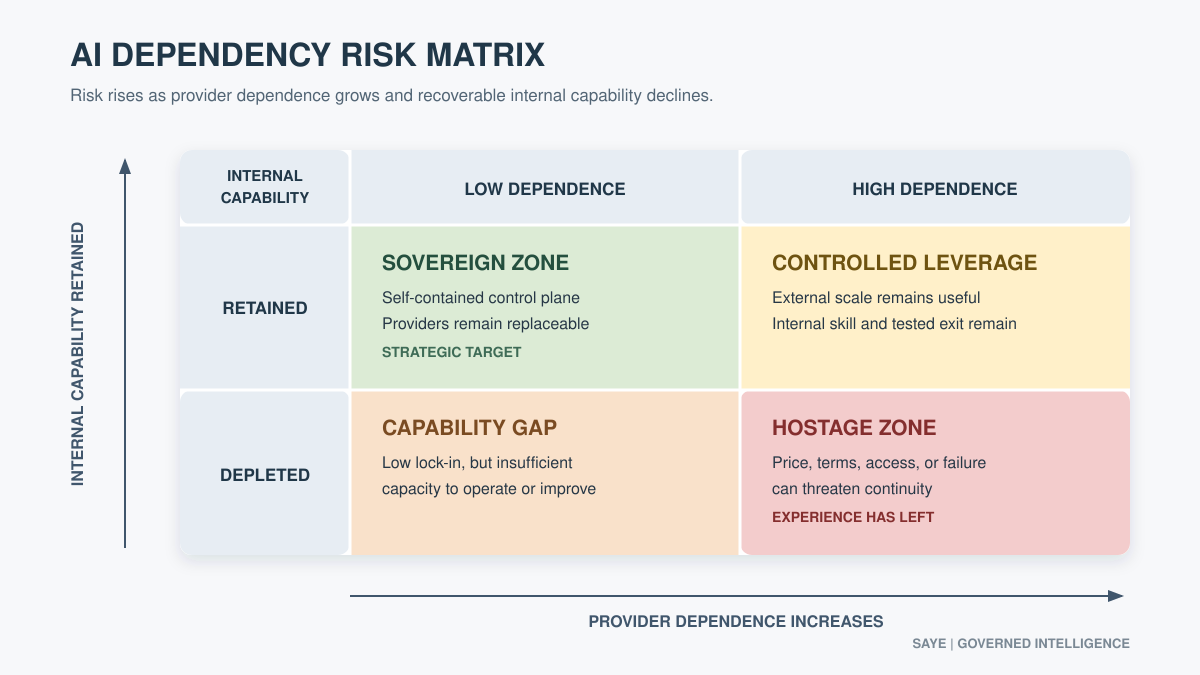
The dangerous movement is diagonally downward: external dependence grows while internal expertise, documentation, and operating practice are allowed to decay. A company can cross into the Hostage Zone while every quarterly automation report still shows savings. By the time the supplier's leverage is exercised, or the supplier simply changes or fails, the experience required to recover has already walked out the door.
Explore with the frontier. Run on what you can prove.
The answer is not to freeze the old world in place. Legacy processes are often slow, expensive, inconsistent, and indefensible. AI should replace waste, expand access to expertise, and perform routine execution at machine speed. The question is whether the institution remains capable of governing the result.
The durable strategy has a specific shape. Analyze and plan before you adopt: price the dependencies, not just the tokens. Use frontier models for exploration and hard cases where they earn their cost. Then convert each running component's requirement into a provider-neutral evaluation and deploy the least expensive, most controllable model that passes it. Where an open-weight or locally operated model meets the standard, it can improve resilience. Where a proprietary model performs best, keep the interface, records, and fallback portable. Explore with the frontier; standardize on proof; own the control plane.
That architecture is only possible if the organization preserves seven things:
One. Human authority. The system may be highly capable without acquiring the right to define its own purpose, enlarge its permissions, or bind the institution outside a traceable delegation.
Two. Institutional memory. Decisions, alternatives, sources, approvals, actions, and results must survive the model session and remain intelligible to people and successor systems.
Three. A self-contained control plane. The organization should own or control its identity, data, institutional memory, permissions, workflows, records, interfaces, and fallback path. Models and cloud services may remain external, but they must remain replaceable components.
Four. Data portability with usable context. Exporting files is not enough. The organization must preserve relationships, provenance, permissions, and the context needed to make the information operational elsewhere.
Five. Revocable delegation. Permissions must be bounded and capable of being narrowed, suspended, or withdrawn without dismantling the entire operating model.
Six. Independent evidence. The system's fluent account of its own conduct cannot be the only proof that the conduct was authorized, accurate, or successful.
Seven. A tested exit. An exit strategy that has never been exercised is a hope. Organizations should regularly prove that another provider, or an internal fallback, can recover a meaningful unit of work.
This is ultimately a governed-AI question
Procurement can negotiate price. Architecture can improve portability. Risk teams can create controls. But none of them alone answers the deepest question: when intelligence is embedded throughout an institution, who retains the authority to set its purposes, constrain its actions, preserve its memory, and revoke its power?
That is the central problem governed AI exists to solve. It concerns the source and limits of authority, the separation of analysis from decision and execution, the rights of the humans affected, and the evidence required to prove that power remained within its grant.
At Saye, we call the answer governed intelligence. Its first principle is simple: capability is not authority. A system's ability to reason, recommend, or act does not give it the right to decide what the institution is for, or to make itself impossible to replace.
The destination is not isolation, and it is not a return to owning every layer of computing. Few organizations should train a frontier model or manufacture their own chips. Self-contained means the company, not its vendor, retains the durable operating core: it can identify its users, reach its data, reconstruct its decisions, enforce its permissions, run its critical workflows, preserve its records, and substitute a model or infrastructure provider without rebuilding the institution from memory. It may rent compute and buy excellent external models, but those services plug into a stack whose meaning, authority, and continuity the company controls.
Every deployment should leave behind better records, more portable processes, stronger internal expertise, and a more credible exit than existed before it. The real AI race is not only a contest to automate the greatest share of work. It is a contest to capture machine leverage without surrendering institutional independence.
The AI trap is not that the machine becomes intelligent. It is that the company lets its own experience disappear, then discovers that continuity depends on terms it can no longer meaningfully refuse.
Saye's vision is a future in which organizations can use the world's best AI without surrendering their judgment, memory, or freedom to choose. Intelligence should operate under human authority, with decisions traceable, rights protected, and every critical capability portable by design. The institutions that thrive will not be those most dependent on AI, but those that make AI powerful without allowing it, or its providers, to become sovereign.
Provided by Saye Consulting.
Source notes
Primary and institutional sources
- Uber Technologies, Inc. Form S-1, U.S. Securities and Exchange Commission. Fare reductions, driver incentives, consumer discounts, network scale and liquidity, and associated financial effects. https://www.sec.gov/Archives/edgar/data/1543151/000119312519103850/d647752ds1.htm
- The 2025 AI Index Report, Stanford Institute for Human-Centered Artificial Intelligence. Measured decline in inference cost for a fixed performance threshold and the narrowing gap between some open- and closed-weight models. https://hai.stanford.edu/ai-index/2025-ai-index-report
- LLM inference prices have fallen rapidly but unequally across tasks, Epoch AI. Performance-adjusted inference-price trends across multiple benchmarks. https://epoch.ai/data-insights/llm-inference-price-trends
- NIST Cloud Computing Program, National Institute of Standards and Technology. Interoperability and portability as major cloud-adoption concerns. https://www.nist.gov/programs-projects/nist-cloud-computing-program-nccp
- Guidelines on Security and Privacy in Public Cloud Computing, National Institute of Standards and Technology. How limited interoperability can complicate the portability of applications and data between providers. https://csrc.nist.gov/pubs/sp/800/144/final
Next step
Where does your operating model actually stand?
If this describes a question you are living with, the useful next move is a conversation about your own systems rather than a general one about the technology.